

On this page
A name older than aviation
The squadron’s name honors the Marquis de Lafayette. He joined the cause of American independence in 1777 and served alongside George Washington, as the National Park Service recounts. The volunteers of 1916 placed their service within that history of assistance between the two countries.
Jean-Claude Lemaire makes the connection between these periods in the preface to The Founders. He places the Memorial within the wider history of Franco-American relations. The name offers a way into that history: a Frenchman went to help Americans in the eighteenth century, and Americans later came to fight in French service in the twentieth.
First an Escadrille Américaine
The unit created in 1916 did not always bear its familiar name. The Library of Congress timeline dates the establishment of the Escadrille Américaine, N124, in the French air service to April 20, 1916.
“American” described the volunteers in the group. It did not mean that the United States had already sent a national military unit to fight in France. The country was still neutral. Distinguishing the pilots’ nationality from the army in which they served helps explain why the name became an issue.
Why the name changed in late 1916
The American Battle Monuments Commission connects the change with German objections and United States neutrality. By late 1916, the formation had become the Lafayette Escadrille.
The new name retained a recognizable American connection through a French figure associated with American independence. It recalled Lafayette’s help to Americans while avoiding the suggestion that the neutral United States had sent a military unit.
A unit’s name and a place of remembrance
After the war, the name also became associated with the Memorial at Marnes-la-Coquette. Dedicated in 1928, the monument recalls American volunteers serving in French aviation. The site’s history extends beyond the squadron’s operational record.
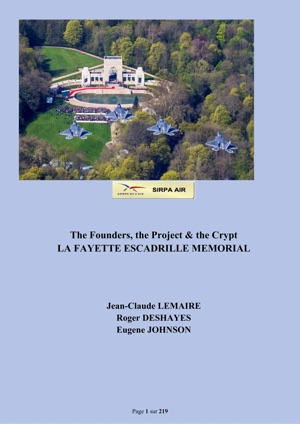
That is the subject of Jean-Claude Lemaire’s books: the people behind the project, the decisions required to build it and the work of preservation. Lafayette’s name connects these histories, but the pilots, the monument’s founders and those responsible for its upkeep do not all play the same role.
Continue in the first book
Start with the first volume’s preface, on PDF pages 3 and 4, to follow the connection between Lafayette and the volunteers. Page 4 mentions 1777 and Washington. The chapters on the founders then show how remembrance became a monument project.
Keeping the dates in order separates three events: 1777 belongs to the American Revolution, 1916 to the unit’s creation and 1928 to the Memorial’s dedication. They are distinct stages, connected by a name and a story of friendship between the two countries.
Sources
- Lemaire and coauthors, The Founders, preface, PDF pages 3-4
- National Park Service, Marquis de Lafayette
- Library of Congress, squadron timeline
- ABMC, Memorial history and change of name
Prepared by the website’s editorial team with AI assistance, using the books and sources listed here. This new article is not authored by Jean-Claude Lemaire. Working review: October 29, 2026.
 Volume 2