
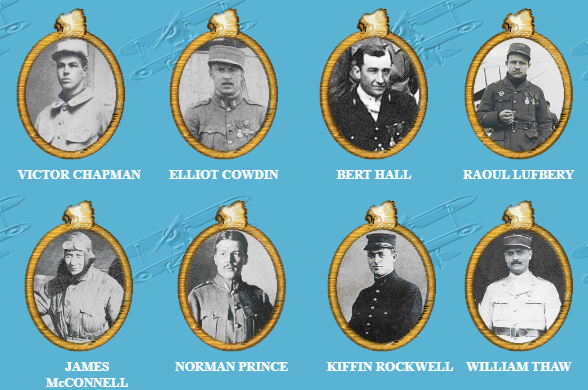
Portraits, paths, and destinies in combat
Behind the name of the La Fayette Escadrille lie men with very different backgrounds, united by the same will: to serve France, sometimes at the cost of their lives. Here are portraits of several notable pilots, drawn from accounts and reference sources devoted to the Lafayette Flying Corps.
Victor Chapman (1890–1916)
An idealist turned fighter, then knight of the skies
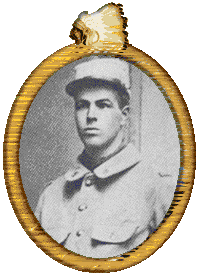
Victor Emmanuel Chapman was born in New York on April 17, 1890. His father, John Jay Chapman, a lawyer and writer, belonged to a prestigious lineage linked to American judicial history. His mother, Minna, from a wealthy Boston family (the Timmins), was deeply Catholic and exercised a major influence on Victor, whom he idolized.
The death of his mother, followed by the tragic death of his brother John Jay (drowned in Austria when Victor was only twelve), profoundly marked his personality. At school, he became moody and inattentive. He completed his secondary education in Germany, also spent time in France, entered Harvard in 1909 and graduated in 1913. Gifted in painting and decoration, he came to Paris to prepare his admission to the École des Beaux-Arts.
When the war broke out, Victor was 24 years old. Against his father’s wishes, he left for France at the end of September 1914 and enlisted in the Foreign Legion. He imagined he was leaving “on a picnic,” but by December he was already serving as a machine gunner in the trenches. Wounded in the right arm, he nevertheless retained his enthusiasm and courage, despite the filth, dysentery, and three consecutive months without rest for his battalion—a record.
He repeatedly tried to rescue comrades who had fallen in No Man’s Land and used his parents’ fortune to help his companions. He was nicknamed “the millionaire American.” In March 1915, he wrote: “One must take all these horrors lightly, otherwise life would quickly become unbearable.”
Thanks to the intervention of his father and his uncle with Norman Prince (without his knowing it), Chapman was transferred to French aviation. He joined V.B. 108 in Nancy as a gunner-bomber. On August 20, 1915, he flew his first mission aboard a Voisin aircraft, and on August 24 he bombed a railway line during a raid on Dillingen.
His request to enter flight school was accepted on September 22, 1915. At Avord, he met Kiffin Rockwell, a former legionnaire like himself, who became his closest friend. He earned his pilot’s certificate on January 9, 1916 and continued his training, notably with Bert Hall among his instructors.
Assigned to N.124, he arrived at Luxeuil on April 20, 1916. He was finally happy in his role as a “solitary knight” in his fighter aircraft. Very quickly, Chapman built a reputation as a fearless combatant, attacking “wherever they were and whatever the circumstances.”
On May 24, 1916, over Verdun, while Thénault wished to avoid a combat considered too risky against twelve German two-seaters over their own lines, Chapman broke formation and dove. A violent fight followed. Chapman, Rockwell, and Thaw were wounded, Thaw seriously.
On June 17, a new act of disobedience: Chapman dove on an enemy formation, attacking two Aviatiks protected by three unspotted Fokkers. His Nieuport was riddled with bullets. One round severed the cable of his aileron, ricocheted, pierced his helmet, and tore into his skull. Covered in blood, he pretended to be dead by putting his aircraft into a spin: the ruse worked, and the Germans abandoned him. He landed, was treated, and returned to base the same day, refusing hospitalization.
On June 23, 1916, initially taking off to bring oranges to a wounded comrade, Chapman joined a patrol engaged against five enemy aircraft. He attacked alone and was pursued by three planes. Witnesses observed his Nieuport badly damaged and uncontrollable, its pilot slumped in the cockpit, before the aircraft crashed six kilometers behind German lines.
His body was never recovered. A funeral service was held at the American Church in Paris on July 4, 1916. Victor Chapman was 27 years old: he was the first American pilot killed during this war.
Elliot Cowdin (1886–?)
From ambulance service to aviation, a controversial path
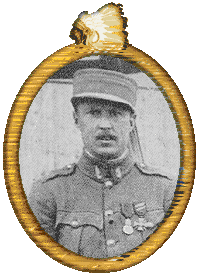
Elliot Cowdin was born on March 3, 1886 in Far Rockaway, Long Island (New York). The son of John Elliot, a ribbon manufacturer and renowned sportsman, he studied at Saint Paul’s School and graduated from Harvard in 1907.
In 1914, he enlisted in Paris in the American Ambulance Service and served with the First Belgian Cavalry Division. Demobilized in February 1915, he joined French aviation and began his training at Pau on March 9. He received his pilot’s certificate on a Voisin aircraft on April 29 and completed his training on May 1, 1915.
On May 3, he was assigned to the V.B. 108 Bombardment Group in Nancy. He took part in the Battle of Artois. Prince and Chapman also served in this unit. Cowdin had met Norman Prince by chance in Paris in February 1915 and had “embraced his cause”: the creation of an American escadrille.
In July 1915, he received the Croix de Guerre with Palm. He left his unit on August 15 to undergo fighter pilot training. He served in several escadrilles: N.38, then N.49, then N.65.
He was one of the three pilots granted leave to the United States for Christmas 1915. He flew with W. Thaw during Verdun, was cited several times, and received a second palm for attacking twelve German aircraft and shooting down a Fokker. He is presented as the first American to receive the French Médaille Militaire.
However, two months after joining the 124, he had to leave the escadrille due to “cardiac troubles.” The account also mentions criticism and controversy surrounding him: relations with command, flights “into bars,” rumors of brawls and extended leaves. A few weeks after joining the 124, he was reportedly brought back to Bar-le-Duc, accused of desertion, and Captain Thénault allegedly asked him to resign to avoid publicity. His departure “was not mourned” by his comrades.
Bert Hall (Weston Birch Hall, 1885–?)
The man of bluff, courage, and internal tensions
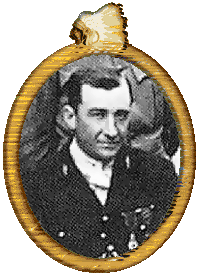
Weston Birch Hall, born on a farm in Missouri on November 7, 1885, grew up between farm labor and a life of adventure: railway worker, chauffeur, “human cannonball” in a Texas circus, sailor, then taxi driver in Paris in 1914.
On August 21, 1914, he was among the first Americans to enlist in the Foreign Legion. He quickly acquired a reputation as a storyteller, recounting various tales about his early aviation exploits. But in the field, he also demonstrated nerve: he took off without knowing how to fly, stalled, and crashed, emerging unscathed. Command concluded that he had “strong enough nerves” to continue training.
After numerous incidents and a difficult training period, Hall was certified. He joined escadrille MS.38 (later N.38), then became an instructor at Avord. Victor Chapman was one of his students. On April 28, 1916, Hall arrived at Luxeuil with other Americans to form the “American Escadrille.”
He was promoted to adjudant on May 1, 1916. On May 22, separated from the others, he engaged an Aviatik alone over Malancourt, fired two bursts into the belly of the two-seater, which exploded and crashed near French trenches. His victory was confirmed even before his return. On June 18, he received the Médaille Militaire and the Croix de Guerre with Palm.
Hall then obtained a second confirmed victory on July 23 and a third on August 28, 1916. However, tensions grew with other American pilots. His temperament, reputation (cheating, forged checks, gambling), and later writings (“En l’air” and One Man’s War) fueled debate and controversy.
After Rockwell’s death, Hall was ultimately expelled from the escadrille. He joined N.103, obtained a fourth victory on November 26, 1916, then left N.103 on December 14, 1916. After that, his movements became difficult to trace.
Raoul Lufbery (1885–1918)
An exceptional pilot, serious, formidable, and mysterious
Raoul Lufbery is presented as the eighth volunteer of the La Fayette Escadrille. Born in Clermont-Ferrand on March 21, 1885, he had an American father and a French mother. Orphaned of his mother at an early age, he lived a turbulent youth: factory work, travel, adventure, service in the American Army (Philippines), then an unexpected career linked to aviation in the Far East as a mechanic and escort on aerial tours.
The death of his friend Marc Pourpe in December 1914 sparked in him a “fierce hatred” of the Germans. He then asked to become a pilot. He obtained his certificate on July 29, 1915, completed his training, and was assigned to V.B. 106.
In May 1916, he joined the Nieuport division of the training group, then the American Escadrille on May 24. Thanks to his mechanical skills, he quickly became renowned for the impeccable condition of his aircraft and its armament.
On July 30, 1916, after sixteen unsuccessful combats, he achieved his first confirmed victory. He then went on to score further victories, receiving the Médaille Militaire and the Croix de Guerre with Palm. Thénault often placed him at altitude above the other fighters to “dominate the situation.” He tolerated high altitudes well, flying at 18,000 feet several times a day.
The text emphasizes his many unconfirmed victories, too far behind French lines to be validated. His official score (17 victories) would not reflect reality. To those who spoke to him of frustration, he replied: “What do I care! I know I got them.”
His comrades described him as serious, reserved, silent, “more closed than an oyster,” speaking with a strong French accent, living to fight, without apparent fear. He nevertheless suffered from severe rheumatism.
He became a Major in the American air service after the dissolution of the La Fayette Escadrille. On May 19, 1918, during a fight against an observation aircraft, his plane caught fire after being hit. He attempted to jump to avoid being burned alive and crashed near Maron. He was reinterred on July 4, 1928 in the crypt of the La Fayette Escadrille Memorial.
James McConnell (1887–1917)
A pilot-writer, marked by pain and determination
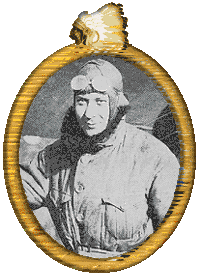
James McConnell was born in Chicago on March 14, 1887. His father was a judge, like his maternal grandfather, and later became president of the Fuller Company in New York and legal representative of Vanderbilt interests. Around the age of ten, James lived in France with his mother and learned French.
As a young student, he became famous for an automobile journey from Chicago to New York. He studied law in Virginia, stood out (Scottish kilt, bagpipes), then was expelled after a provocative act during an inauguration linked to Thomas Jefferson. He then worked in railroads before leaving for France in 1915.
He served as a driver in the Ambulance Corps near the front. Awarded the Croix de Guerre on October 15, he felt “safely tucked away” and wanted to enter aviation. He obtained his pilot’s certificate on a Blériot on February 6, 1916, continued training on Nieuports, joined the reserve near Paris, and was immediately assigned to the American Escadrille. He had his nickname painted on his Nieuport: MAC.
At Behonne, near Verdun, he took part in missions protecting reconnaissance aircraft and artillery observation planes. On June 23, his friend Victor Chapman was killed. McConnell vowed to avenge his death.
Wounded in the back during a forced landing, he continued flying despite the pain, until he could no longer walk without a cane. Hospitalized, he learned of Rockwell’s death. He stayed with Madame Alice Weeks and continued writing his book on the escadrille. He joined Cachy on November 11, flew little, and his condition deteriorated.
His book Flying For France was published and well received in the United States, fueling patriotic sentiment. But McConnell returned to combat despite an alarming physical condition.
On March 19, 1917, during a patrol over the Somme, he was seen pursuing a German aircraft. He never returned. His Nieuport was found destroyed, and his body was recovered. Thénault opened a letter left by McConnell, in which he stated that he wanted “no service,” adding: “God damn the Germans and Long Live France.”
He was buried on the battlefield, then transferred in 1928 to the crypt of the La Fayette Escadrille Memorial.
Norman Prince (1887–1916)
The driving force of the project, between diplomacy, aviation, and tragedy
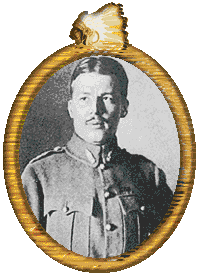
Norman Prince was born on August 31, 1887 in Pride Crossing, Massachusetts. The son of Frederick Henry Prince, an industrialist and banker, he graduated from Harvard in Arts and Law (1911). A lawyer in Chicago, he was in reality passionate about aviation. He took flying lessons under an assumed name so as not to upset his father, who viewed airplanes as “smelly chicken coops.”
He obtained his pilot’s license (No. 55). From the very beginning of the war, he wanted to serve France, which he considered his “second homeland.” He arrived in France at the end of January 1915 and spent weeks promoting his idea: to create an escadrille composed exclusively of American volunteers. French authorities hesitated: there were more pilot candidates than available aircraft.
Despite this, Prince enlisted in the Legion and was then transferred to the aviation school at Pau. He received his military pilot’s certificate on May 1, 1915. He served in units V.B. 108 and then V.B. 113. The project advanced thanks to support and networks, and a Christmas 1915 leave to the United States with Thaw and Cowdin accelerated the momentum.
Escadrille N.124 was officially formed in April 1916. After the first patrols, the unit was sent to Verdun. Chapman was shot down on June 23.
Prince sought in particular to shoot down observation balloons. He achieved several victories and received the Médaille Militaire on September 26, 1916. After the major raid on Oberndorf on October 12, Prince shot down a Fokker (his fourth victory). But upon landing in the dusk, he struck telephone wires and crashed, gravely wounded. He died on October 15, 1916 at the age of 29, without regaining consciousness. He was buried at Luxeuil.
Kiffin Rockwell (1892–1916)
The soul of the escadrille, first victor, tragic hero
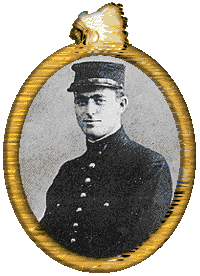
Kiffin Rockwell was born in Newport, Tennessee, on September 20, 1892. After an outdoor-oriented youth, he wanted to become a soldier. From the declaration of war, he and his brother Paul sought to serve France.
They enlisted in the Foreign Legion and went to the front. Paul was seriously wounded in December 1914. Kiffin, nicknamed “Rocky,” was wounded in the thigh during an assault. While convalescing, he met Thaw and requested a transfer to aviation. He obtained his military pilot’s certificate on October 22, 1915, first in his class.
On his fourth patrol, he accomplished the historic sortie: over Thann, despite an unsteady engine, he dived on an L.V.G. and shot it down. The victory was confirmed by a French observation post: it was Rockwell’s first victory and the first of the escadrille.
At Luxeuil, his comrades carried him in triumph. A bottle of Bourbon became a “ceremony”: each pilot who shot down an enemy aircraft would earn a sip, nicknamed “the bottle of death.”
On May 24, 1916, during the violent combat initiated by Chapman against twelve two-seaters, Rockwell was badly wounded in the face. He shot down a two-seater (unconfirmed victory), refused hospitalization, but eventually had to receive care. He returned to combat, accumulated engagements, complained of a lack of recognition, and entered into conflict with Thénault and Prince.
He achieved a second official victory on September 9, 1916. On September 23, he dived on a German observation two-seater. A French observer witnessed the combat, but Rockwell was struck by a fatal burst: his Nieuport plunged, a wing detached, and he crashed. He was mortally wounded in the chest by an explosive bullet.
Thénault declared through tears: “Wherever Rockwell was in the air, no German got through. The best and bravest of us all is gone.”
Rockwell was posthumously promoted to second lieutenant and made a Knight of the Legion of Honor.
William Thaw (1893–?)
The pilot-negotiator, natural leader of the American group
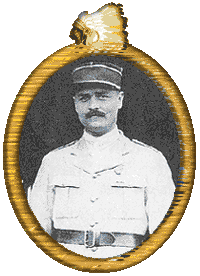
William Thaw was born in Pittsburgh on August 12, 1893, into a very wealthy family. A student at Yale, he left the university for the emerging field of aviation. He learned to fly with Curtiss, became a member of the Aero Club of America, lived spectacular aerial adventures, carried passengers, competed in races, and stayed on the French Riviera, earning the nickname “Playboy of the Riviera.”
At the beginning of the war, he offered his seaplane to the French government. Then, answering Blaise Cendrars’ call, he enlisted in the Foreign Legion as a simple infantryman. Very quickly, he sought to join aviation and also worked to have his comrades transferred there.
He became the first American to serve at the front in a French escadrille (D.6) as a soldier-gunner. He carried out reconnaissance flights, then obtained his military pilot’s certificate (No. 714) on a Caudron G.2, thus becoming the first American pilot to obtain a French license.
Thaw and Prince shared the same idea of creating an American escadrille. In December 1915, with Prince and Cowdin, he obtained leave to the United States. The media impact strengthened French interest in the project. Upon their return, the creation of the escadrille became a reality.
On May 24, 1916, Thaw shot down a Fokker and later a second one before his machine gun jammed. Wounded in the shoulder, with his fuel tank pierced, he managed a forced landing, burned by gasoline, and was hospitalized. Promoted to lieutenant, he became the “de facto commander” of the American pilots, whom he knew how to guide and appease thanks to his negotiating skills with French command.
The text credits him with five official victories and numerous decorations. He later left French aviation service to become a Major in the American air service.
Sources
All rights reserved “The Lafayette Flying Corps”: The American Volunteers in the French Air Service in World War One — Author: Dennis Gordon — Translation: Roger Deshayes.
Complete list of the pilots of the Lafayette Flying Corps
Beyond the most well-known figures of the La Fayette Escadrille, the Lafayette Flying Corps brought together 269 volunteer pilots, mainly Americans, who served in the French Air Service during the First World War.
This list, extracted from the reference work by Dennis Gordon, reflects the scale of this exceptional commitment and the diversity of the paths taken by these men, many of whom lost their lives in service.
LIST OF THE 269 PILOTS OF THE LAFAYETTE FLYING CORPS
Extracted from the book by Dennis Gordon, “The Lafayette Flying Corps”, published by Schiffer Publishing Ltd.
Library of Congress Catalog Number: 99-68886
Contact: Schifferbk@aol.com – www.shifferbooks.com
ABBOTT, WAINWRIGHT
ADAMS, JOHN RUSSELL
ALLEN, SIDNEY THAYER
APPLETON, JR, WALTER K.
ASH, ALAN NEWTON (DIED IN SERVICE)
ATEN, ARTHUR MILLS
BACH, JULES JAMES
BAER, PAUL FRANK
BAIRD, BENJAMIN HESTER
BALSLEY, HORACE CLYDE (LAFAYETTE ESCADRILLE)
BARCLAY, LEIF NORMAN (DIED IN SERVICE)
BASSETT, JR., CHARLES CHESTER
BATCHELOR, HENRY AUGUSTUS
BAUGHAM, JAMES HENRY (DIED IN SERVICE)
BAYLIES, FRANK LEAMAN (DIED IN SERVICE)
BAYNE, JAMES ALEXANDER (DIED IN SERVICE)
BENNY, PHILIP PHILLIPS (DIED IN SERVICE)
BENOÎT, LEO E. (BENWAY, ERNEST L.)
BIDDLE, CHARLES JOHN
BIDDLE, JULIAN CORNELL (DIED IN SERVICE)
BIGELOW, STEPHEN SOHIER (LAFAYETTE ESCADRILLE)
BLAKE, CHARLES RAYMOND
BLUETHENTHAL, ARTHUR (DIED IN SERVICE)
BOAL, PIERRE
BOGOS, ELLISON CONVERSE
BOOTH, JR., WILLIAM VERNON (DIED IN SERVICE)
BOSWORTH, CLARENCE MARSH
BOULIGNY, EDGAR JEAN
BOYESEN, ALGERNON
BRADY, LESTER STRAYER
BRIDGMAN, RAY CLAFLIN (LAFAYETTE ESCADRILLE)
BROWN, JASPER CORNISH
BROWN, STAFFORD LEIGHTON (DIED IN SERVICE)
BUCKLEY, EVERETT TIMOTHY
BUFFUM, THOMAS BRADLEY
BULLARD, EUGENE JACQUES
BULLEN, RICHARD NIXON
BULLEN, WILLIAM GRAHAM
BUSH, PHILIP NELSON
BYERS, LOUIS LESLIE
CAMPBELL, ANDREW COURTNEY, JR. (LAFAYETTE ESCADRILLE-DIS)
CAMPBELL, HUGH GORDON
CARRERE, JR, JOSEPH MAX WELL
CASSADY, THOMAS GANTZ
CHADWICK, OLIVER MOULTON (DIED IN SERVICE)
CHAMBERLAIN, CYRUS FOSS (DIED IN SERVICE)
CHAPMAN, CHARLES WESLEY (DIED IN SERVICE)
CHAPMAN, VICTOR EMMANUEL (LAFAYETTE ESCADRILLE-DIS)
CHARTON, LOUIS
CHATKOFF, HERMAN LINCOLN
CLAPP, ROGER HARVEY (DIED IN SERVICE)
COATSWORTH, CALEB JAMES
COLLIER, EDWARD M.
COLLINS, PHELPS (DIED IN SERVICE)
CONNELLY, JAMES ALEXANDER
COOK, ALAN AUGUSTUS
COOKSON, LINN PALMER (DIED IN SERVICE)
COREY, RUS SELL BRACKEN
CORSI, EDWARD CHARLES
COTTON, JOHN ROWELL
COURT, ISADORE
COWDIN, ELLIOT CHRISTOPHER (LAFAYETTE ESCADRILLE)
CREHORE, AUSTEN BALLARD
CUNNINGHAM, ARTHUR LAWRENCE
CURTIS, FRAZIER
CUSHMAN, ALVAN ALEXANDER
DAVIS, PHILIP WASHBURN (DIED IN SERVICE)
DOCK, JR, GEORGE
DOLAN, CHARLES HEAVE (LAFAYETTE ESCADRILLE)
DONZE, ROBERT LOUIS
DOOLITTLE, JAMES RALPH (LAFAYETTE ESCADRILLE-DIS)
DOWD, DENNIS (DIED IN SERVICE)
DOWD, MEREDITH LOVELAND (DIED IN SERVICE)
DREW, JR, SIDNEY RANKIN (DIED IN SERVICE)
DREXEL, JOHN ARMSTRONG (LAFAYETTE ESCADRILLE)
DUFFY, NATHANIEL EDMUND
DUGAN, JR, WILLIAM EDWARD (LAFAYETTE ESCADRILLE)
DULON, LOWELL RICHARDS
EATON, SHERBURNE
EDGAR, STUART EMMET (DIED IN SERVICE)
ELDREDOE, DONALD HERBERT
ELLIOTT, CHESTER ARTHUR
ELY, DINSMORE (DIED IN SERVICE)
ENDICOTT, JOHN
EOFF, ROBERI GRIMSHAW
FAIRCHILD, EDWIN BRADLEY
FAITH, CLARENCE HENRY
FAUNTLEROY, CEDRIC ERROLL
FERGUSON, IAN FEARCHAR
FLYNN, JOSEPH
FORD, CHRISTOPHER WILLIAM (LAFAYETTE ESCADRILLE)
FORD, TOD
FORSTER, HENRY
FOWLER, ERIC ANDERSON (DIED IN SERVICE)
FREY, WILLIAM
GENET, EDMOND CHARLES CLINTON (LAFAYETTE ESCADRILLE-DIS)
GIBSON, WILLIAM WALLACE
GILL, JOSEPH FRANCIS
GILMORE, WILLIAM SMITH
GLOVER, CLARENCE MERRITT
GOURARD, REGINALD G.
GREY, CHARLES GOSSAGE
GRIEB, HENRY NORMAN (DIED IN SERVICE)
GRIER, JAMES MURRAY
GUEST, DAVID PORTER
GUNDELACH, ANDRE (DIED IN SERVICE)
GUY, DAVID WADE
HALL, JAMES NORMAN (LAFAYETTE ESCADRILLE)
HALL, WESTON BIRCH (BERT) (LAFAYETTE ESCADRILLE)
HAMILTON, EDGAR GUERARD
HANFORD, ROBERT MARSHALL (DIED IN SERVICE)
HARRISON, JR, JOHN B.
HAVILAND, WILLIS BRADLEY (LAFAYETTE ESCADRILLE)
HEILBUTH, JOHN RAYNOLDS
HEWITT, JR, THOMAS MOSES (LAFAYETTE ESCADRILLE)
HICKSON, LESLIE MATHESON
HILL, DUDLEY LAWRENCE (LAFAYETTE ESCADRILLE)
HINKLE, EDWARD FOOTE (LAFAYETTE ESCADRILLE)
HITCHCOCK, JR., THOMAS
HOBBS, WARREN TUCKER (DIED IN SERVICE)
HOEBER, ROBERT BENTLEY
HOLDEN, MILTON WHITELY
HORTON, CHARLES DABNEY
HOSKIER, RONALD WOOD (LAFAYETTE ESCADRILLE-DIS)
HOUGH, EDWIN A.
HUFFER, JOHN WILLIAM
HUGER, DANIEL ELLIOTT
HUGHES, EARL WAYLAND
HULL, MARK LESLIE
JACOB, SERENO THORP
JOHNSON, CHARLES CHOUTEAU (LAFAYETTE ESCADRILLE)
JOHNSON, HARRY FIRMSTUNE (DIED IN SERVICE)
JOHNSTON, ARCHIBALD BURTT
JONES, CHARLES MAURY
JONES, HENRY SWEET (LAFAYETTE ESCADRILLE)
JUDD, EDWARD DAVID
KENYON, HUGO ALDEN
KERWOOD, CHARLES WAYNE
KINSOLVINO, CHARLES MCILVAINE
KIRKWOOD, WILLIAM FRANCIS
KOWALL, JOHN ROBERT
KRUIJFF, THEODORE DE
KYLE, GEORGE MARION
LARNER, GORMAN DE FREEST
LEE, HENRY S.
LEE, SCHUYLER (DIED IN SERVICE)
LEHR, MANDERSON (DIED IN SERVICE)
LEWIS, DAVID WILBUR
LITTAUER, KENNETH PROCTER
LOOMIS, RALPH LANE
LOOMIS, WILLIAM FITCH
LOUGHRAN, EDWARD (DIED IN SERVICE)
LOVELL, WALTER (LAFAYETTE ESCADRILLE)
LUDLAM, W. LESLIE
LUFBERY, RAOUL GERVAIS (LAFAYETTE ESCADRILLE-DIS)
McCALL, GEORGE ARCHIBALD
McCONNELL, JAMES ROGERS (LAFAYETTE ESCADRILLE-DIS)
McCREARY, JR. JAMES B.
McGINN, WILLIAM
McKEE, HERSHEL
McKERNESS, WILLIAM JOHN (DIED IN SERVICE)
McMILLEN, JAMES HAITT
MACKE, GORDON B.
MACMONAGLE, DOUGLAS (LAFAYETTE ESCADRILLE-DIS)
MAGLEY, GUY BERTRAM
MALONE, CHARLES THOMAS
MANIERRE, HAROLD L.
MARR, KENNETH ARCHIBALD (LAFAYETTE ESCADRILLE)
MASSON, PIERRE DIDIER (LAFAYETTE ESCADRILLE)
MEEKER, WILLIAM HENRY (DIED IN SERVICE)
MILLER, ALVIN FORD
MILLER, GEORGE
MILLER, WALTER BERNARD (DIED IN SERVICE)
MILES, GORDON R.
MOLTER, BENNET ARTHUR
MOORE, ROBERT LOUIS
MOSELEY, GEORGE CLARK
MOUVET, OSCAR
MUNSON, CURTIS B.
NICHOLS, ALAN HAMMOND (DIED IN SERVICE)
NORDHOFF, CHARLES BERNARD
OAKES, JR, NATHAN PRINCE
OVINGTON, CARTER LANDRAM (DIED IN SERVICE)
PADEN, DAVID
PALMER, HENRY BREWSTER (DIED IN SERVICE)
PARKER, AUSTEN GILETTE
PARSONS, EDWIN CHARLES (LAFAYETTE ESCADRILLE)
PAVELKA, PAUL (LAFAYETTE ESCADRILLE-DIS)
PELTON, ALFRED DIGBY (DIED IN SERVICE)
PETERSON, DAVID McKELVY (LAFAYETTE ESCADRILLE-DIS 16 MARCH 1919)
POLLOCK, GRANVILLE ALEXANDER
PONDER, WILLIAM THOMAS
POTTER, THOMAS WINDEATT
PRINCE, JR, FREDERICK HENRY (LAFAYETTE ESCADRILLE)
PRINCE, NORMAN (LAFAYETTE ESCADRILLE-DIS)
PUTNAM, DAVID ENDICOTT (DIED IN SERVICE)
RAND, RUFUS RANDALL
RANDALL, JOHN FRANCIS
READ, ROBERT EMERY
RENO, LEONARD MINOR
RHENO, WALTER DAVIS (DIED IN SERVICE)
RIDLON, HUGH OWEN
ROCKWELL, JR, GEORGE J.
ROCKWELL, KIFFIN VATES (LAFAYETTE ESCADRILLE-DIS)
ROCKWELL, ROBERT LOCKERBIE (LAFAYETTE ESCADRILLE)
ROCLE, MARJUS ROMAIN
RODGERS, JR., WILLIAM BLACKSTOCK
ROLF, JR, JOHN F.
ROODE, CLIFFORD DE
ROSS, RAYMOND THOMAS
ROTHARMEL, KENNETH
ROUNDS, LELAND LASELL
RUMSEY, JR, LAURENCE DANA (LAFAYETTE ESCADRILLE)
SAUL, JOSEPH ROE
SAXON, HAROLD YOUNG
SCANLAN, LAWRENCE
SCHREIBER, EDWIN BOOTH (DIED IN SERVICE)
SEAVER, HORACE
SHAFFER, WALTER JOHN
SHIPLEY, WALTER B.
SHONINGER, CLARENCE BERNARD
SINCLAIRE, REGINALD
SITTERLY, GLENN NELSON
SKINNER, SAMUEL WIGGINS (DIED IN SERVICE)
SOUBIRAN, ROBERT (LAFAYETTE ESCADRILLE)
SPEERS, WALLACE
SPENCER, DUMARESQ (DIED IN SERVICE)
STANLEY, ALFRED HOLT
STARRET, JR. FRANK ELMER (DIED IN SERVICE)
STEARNS, RUS SELL FALCONER
STEHLIN, JOSEPH CHARLES
STICKNEY, HENRY ELMER
STONE, DONALD EDWARD (DIED IN SERVICE)
STONE, GERALD STARR
SULLIVAN, UPTON SUPPLE
TABER, LESLIE RAY
TAILER, WILLIAM HALLET (DIED IN SERVICE)
TAYLOR, ELMER BOWDEN (DIED IN SERVICE)
TERRES, HUGH (DIED IN SERVICE)
THAW, WILLIAM (LAFAYETTE ESCADRILLE)
THOMPSON, CLIFTON BADLAM
TRINKARD, CHARLES (DIED IN SERVICE)
TUCKER, DUDLEY GILMAN (DIED IN SERVICE)
TURNURE, JR, GEORGE EVANS
TYSON, STEPHEN MITCHELL (DIED IN SERVICE)
VAN FLEET, JR, WILLIAM CAREY
VEIL, CHARLES HERBERT
WAINWRIGHT, NEAL
WALCOTT, BENJAMIN STUART (DIED IN SERVICE)
WASS, WILLIAM ETHELBERT VAN
WELLMAN, WILLIAM AUGUSTUS
WELLS, FRANK WILLARD
WHITMORE, HERMAN KOTZCHMER
WHITMORE, JOHN JOYCE
WILCOX, CHARLES HERBERT
WILD, MARCELLUS EDWARD
WILLARD, GEORGE GALE
WILLIS, HAROLD BUCKLEY (LAFAYETTE ESCADRILLE)
WILLOUGHBY, WESTEL ROBINSON
WILSON, JOSEPH VOLNEY (DIED IN SERVICE)
WILSON, PIERRE MARIE
WINSLOW, ALAN FRANCIS
WINSLOW, CARROLL DANA
WINTER, JR, CHARLES WALLACE (DIED IN SERVICE)
WOODWARD, HENRY HOUSTON (DIED IN SERVICE)
WORTHINGTON, WARWICK
WRIGHT, HAROLD EVERETT
YORK, WALTER RAYMOND (DIED IN SERVICE)
ZINN, FREDERICK WILHELM
Source
Excerpt from Mr. Roger Deshayes’ website
https://www.lafayettememorialclefs.fr