
The First World War marked the rapid rise of military aviation. From the very first years of the conflict, control of the skies became a major strategic objective. In this field, German aviation long maintained a clear advantage over the Allied forces, both in aircraft design and armament.
Une supériorité allemande initiale dans le domaine aéronautique
German aviation consistently enjoyed a certain technological edge over the Allies in the field of aircraft and weaponry.
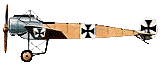
During the summer of 1915, this superiority became evident with the appearance of the Fokker E.I and E.III fighters. These aircraft had a high operational ceiling and were equipped with belt-fed machine guns firing through the propeller thanks to a synchronization system. This innovation allowed German pilots to attack in a dive and fire longer, more effective bursts.
The Allied Response and Rapid Aircraft Development
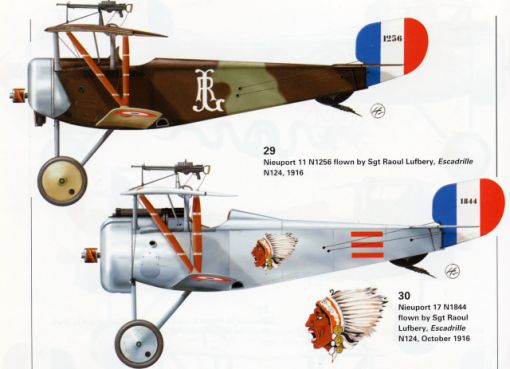
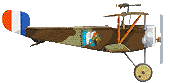
In response to this advantage, Allied aviation temporarily regained the upper hand with the introduction of the Nieuport 11, a light and highly maneuverable fighter that helped counter the Fokker aircraft.
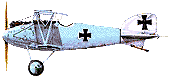
However, this advantage was short-lived. The Germans quickly regained superiority with the arrival of the Albatros D.1, fitted with twin Spandau machine guns and powered by a 160-horsepower Mercedes engine, offering improved speed and firepower.
1917: Intensified Technological Competition
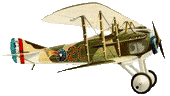
In 1917, the French introduced an excellent aircraft, the SPAD XIII, equipped with two belt-fed Vickers machine guns. This fighter represented a significant advancement for Allied aviation.
Nevertheless, German machine guns remained more effective. In addition, German aviation began to focus on pilot comfort and survival by introducing heated flight suits, parachutes, and oxygen masks—equipment that was still rare or absent among the Allies at that time.
The Fokker D.VII: German Supremacy in 1918
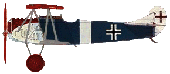
In April 1918, Germany introduced what is widely regarded as the finest fighter aircraft of the war: the Fokker D.VII. This aircraft outperformed all Allied fighters, confirming Germany’s technological superiority in the final phase of the conflict.
Pilot Training: A Decisive Advantage
German superiority did not rely solely on aircraft quality. German pilots also benefited from a far more comprehensive training program.
This training included:
- basic instruction on two-seat aircraft,
- a minimum of six months of flight training,
- fighter training under the critical supervision of the aces of German aviation.
This thorough preparation played a key role in the operational effectiveness of German air units.
Distinct Aerial Tactics
German aerial tactics differed significantly from those of the Allies.
German pilots generally operated above their own lines, reducing the risks associated with mechanical failure or injury. While Allied formations typically flew in a V formation, German aircraft flew in line formation, allowing for faster deployment, although this configuration was less advantageous in the event of an attack from above.
Unlike the French, German forces did not conduct regular patrols. Instead, they moved their canvas hangars to any point along the front as needed. Pilots waited for observers to report the arrival of Allied aircraft or scanned the sky with binoculars before taking off.
This mobile organization earned them the nickname “Flying Circus”, both because their hangars moved like circus tents and because of their tactic of forming a circle in which Allied fighters could become trapped, running the risk of being fired upon from behind.
Source
Excerpt from Mr. Roger Deshayes’ website
https://www.lafayettememorialclefs.fr