
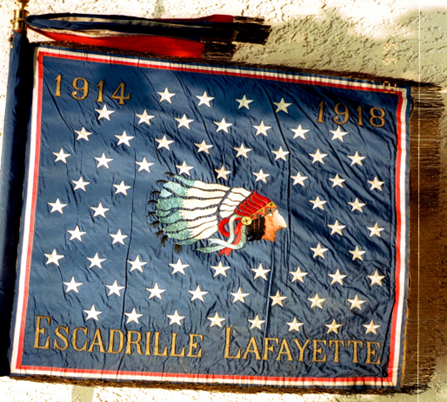
An extraordinary human and military adventure
The history of the Lafayette Escadrille is one of the least known, yet also one of the most glorious chapters of the First World War. It embodies a voluntary, selfless and deeply symbolic commitment, at a time when the United States had not yet officially entered the war.
American volunteers driven by the spirit of freedom
In August 1914, at the time of the general mobilization, several young Americans were staying in France. Most of them came from wealthy families, were accomplished sportsmen and adventurous by nature, leading privileged lives. Some took part in offshore yacht races with their own yachts, while others competed in aviation contests with their own personal aircraft.
One event, however, was to profoundly change their destiny. A manifesto signed by the writer Blaise Cendrars, calling on foreigners living in France to enlist alongside the French army, appeared in the press. This appeal resonated deeply with these young men, who were devoted to freedom and driven by a strong ideal of commitment.
However, answering this call was not without consequences. As the United States was then neutral, any American citizen serving under a foreign flag risked losing his nationality. A solution was suggested to them by the United States Embassy in Paris: to enlist either as combatants in the Foreign Legion, or as non-combatants in the voluntary ambulance services. All of them accepted without hesitation.
William Thaw and the entry of Americans into French aviation
Among these volunteers was William Thaw, the son of a billionaire from Pittsburgh. Present in France to take part in the Schneider Cup, a prestigious air race, he enlisted as an infantryman after a brief military training and was sent to the front.
After several months spent in the trenches, his unit was sent to rest. Thaw then learned of the existence of an airfield. He went there, met a French officer and expressed his desire to serve in aviation. At that time, aviators enjoyed a level of prestige comparable to that of astronauts today. The French air force was still in its infancy, but the officer kept his word: William Thaw became the first American admitted to a French flight school.
At the end of his training, he was assigned to a bombing squadron.
Norman Prince and the birth of the American squadron project
The paternity of the Lafayette Escadrille is generally attributed to Norman Prince, a 27-year-old lawyer and Harvard graduate. His father, a wealthy financier, had granted the French Republic considerable war loans. Norman had spent part of his childhood in France, notably in Pau, where his father organized hunts that brought together the elite of society.
A licensed pilot since 1911 with the Fédération Aéronautique Internationale, Norman Prince very early nurtured an ambitious project: to create a squadron composed exclusively of American pilots fighting under French command.
After a brief passage through the Foreign Legion, he was assigned as a simple soldier to a bombing unit. At that time, sixteen Americans were already flying under French roundels.
Decisive media and political recognition
During the Christmas holidays of 1915, William Thaw, Norman Prince and the pilot Cowdin obtained leave to return to the United States. The American press, already fascinated by the exploits of these young volunteers, gave them a triumphant welcome in New York. They became true public figures.
Upon their return to France, Prince and his companions were received by the Secretary of State for Aeronautics. The French government closely followed the evolution of the American press, which saw in these pilots an example likely to encourage the abandonment of American isolationism.
The parallel with the Marquis de La Fayette, who had come to fight for American independence in the 18th century, naturally imposed itself.
The creation of Squadron N 124
The French High Command was then invited to regroup all American pilots scattered among French units. Thus was created the so-called “American Squadron,” placed under the command of Captain Thénault, assisted by Lieutenant de Laage de Meux.
In April 1916, Squadron N 124 received all of its personnel, composed of eighty men—mechanics, drivers, clerks, cooks—as well as its first American pilots, among whom were Thaw, Prince, Cowdin, Victor Chapman, Kiffin Rockwell, James McConnell, Bert Hall and, a little later, Raoul Lufbery.
The first combats and life within the squadron
Based in Luxeuil-les-Bains, close to the front, the squadron finally received its first fighter aircraft: Nieuports, small and highly maneuverable planes capable of reaching 170 km/h and armed with a machine gun, a major innovation at the time.
On May 18, 1916, Kiffin Rockwell achieved the squadron’s first aerial victory by shooting down a German aircraft. This event was celebrated with great enthusiasm.
Daily life for the pilots was marked by a certain conviviality. The squadron’s mess, financed by a wealthy American and run by a former chef from the Ritz in New York, was well known throughout the region. Two lions, Whisky and Soda, served as mascots and contributed to the legend of the group.
Heavy losses and total commitment
Behind this apparent carefreeness lay a harsh reality. Missions were dangerous and losses frequent. Sent to Verdun and then to the Somme, the squadron faced extreme weather conditions and relentless aerial combat.
Kiffin Rockwell was killed in action. Norman Prince, seriously wounded during a mission, died a few days later. Despite these losses, the squadron continued to fight with determination.
On August 16, 1917, General Pétain awarded the squadron a citation at the order of the army, praising its spirit of sacrifice and its aerial victories.
From the American Squadron to the Lafayette Escadrille
German authorities protested against the existence of an “American Squadron,” seeing it as a violation of United States neutrality. To avoid any diplomatic incident, the unit was renamed the Lafayette Escadrille, in homage to the famous Marquis.
Its insignia, a Sioux head, became emblematic.
Heritage and transmission
After the United States entered the war in 1917, the American pilots gradually joined the newly created American air service. On February 18, 1918, the Lafayette Escadrille ceased to exist in its original form and became the first American fighter squadron.
Its heritage nevertheless endured. The traditions, the insignia and the memory of its pilots were passed on to subsequent French units, up to the present day.
A memory sustained by reference works
For those who wish to explore this exceptional history further, the works dedicated to the Lafayette Escadrille constitute essential references. They retrace with documentary rigor the journey of these men, their commitment and the lasting impact of their action.
Conclusion: a brotherhood of arms turned into a symbol
The Lafayette Escadrille is not merely a military unit. It is the symbol of a brotherhood between two nations, of a voluntary commitment in the service of universal ideals, and of a sacrifice made in the name of freedom.
Even today, its history resonates as a timeless testimony to courage and to the shared memory between France and the United States.
Source
Excerpt from Mr. Roger Deshayes’ website
https://www.lafayettememorialclefs.fr